|
Lorna Mills and Sally McKay
Digital Media Tree this blog's archive OVVLvverk Lorna Mills: Artworks / Persona Volare / contact Sally McKay: GIFS / cv and contact |
View current page
...more recent posts

(found)
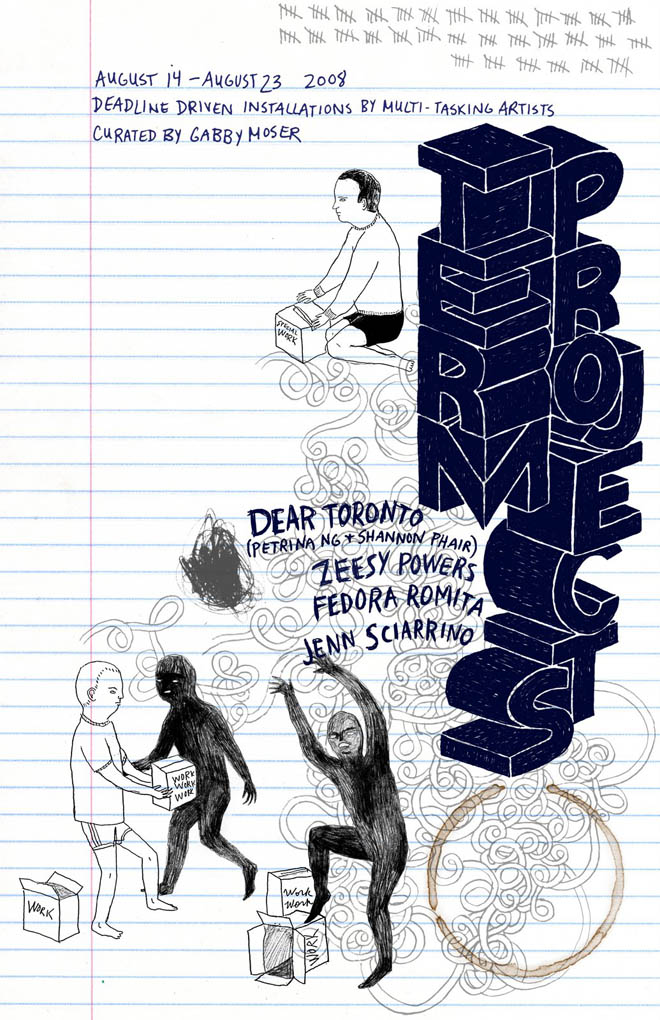
XPACE 58 Ossington Ave., Toronto Tuesday-Saturday, noon-6
August 14 to August 23 2008
Opening Reception: Thursday, August 14, 7-10 pm
Featuring the Zeesy Powers Grant Awards Ceremony at 8:30 pm and music by DJ WMD
(found)
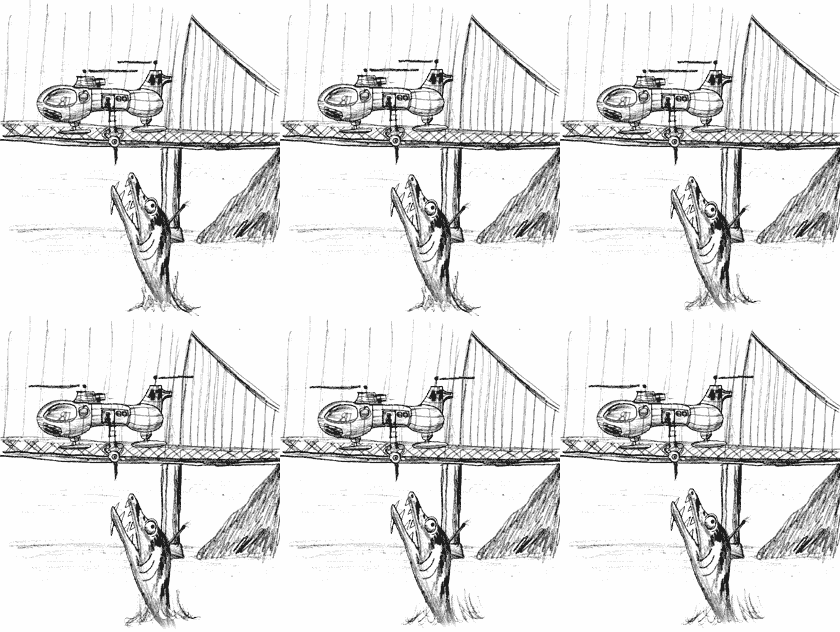
Sunday Devotional: Herp Albert & the Tijuana Brass

(found by L.M.)
Notes on Blogging
I really like the recent bubble of talk at simpleposie about AGYU's advocacy work. I'm in favour of the project, myself, and I also think the discussion around it is really valuable. It's not just good in the specific instance, but it's good in general, that any art issue, at any time, can now be taken up and debated in public.
I was really influenced in the 90s by an essay that Kevin Dowler wrote for YYZ book Theory Rules. Dowler talked about the very poor way in which art professionals tried to defend the National Gallery's exhibition of Vanitas by Jana Sterbak (better known as 'the meat dress'), and their acquisition of Barnet Newman's Voice of Fire by claiming that decisions on the value of art were best left to art experts.
Until recently, the uselessness of art, its pure negativity, ensured its freedom to function as critique, since it rested beyond (and therefore was incapable of infecting) the horizon of everyday life. However, with the erosion of the autonomy of aesthetic practices and the broadening of the scope of reception (once encouraged by the avant-garde), art can no longer hold the privileged position that was the sign of both its freedom from constraint and its lack of utility.In other words, the way I understood it, contemporary art's value in society was diminished by expert claims that the criteria for judging art were only inherent to the art world itself.
Kevin Dowler, "In Defence of the Realm: Public Controversy and the Apologetics of Art", in Theory Rules (Toronto: YYZ Books, 1996) p.82
One of the motivations for starting Lola magazine was to emphasise the vitality of contemporary art by demonstrating that it indeed had meaning and impact beyond the select realm of art experts. The project was not welcomed by everyone. I recently received an email from a Lola reader saying "...I bitched a lot about Lola way back ... because it seemed too lowbrow and scene-y..." Those were the days before blogs, when art discourse was pretty much restricted to print media. The dearth of arts coverage was bemoaned by people who naturally wanted reviews, but it also created a weird sense of security. Artists were public figures and art was a public experience, but you could pretty much guarantee that nobody would ever publicly challenge your work unless you were super famous.
With blogs, the public nature of all art practice is more healthy and functional. It still feels like early days. There is a sense of surprise on the part of the artist when all of a sudden their project is being heatedly discussed online. And it's not pleasant to be criticized, especially if you don't think the critic has put any rigorous thought into their comments. But unlike a Globe and Mail review by John Bentley Mays which the artist must passively receive as if a judgement from on high, these threads are discussions with multiple points of view, and the artist can join in and defend themselves. Not only that, but any and all art projects, including those that might never register on the radar of print media critics, could be up for discussion at any moment. The artist is denied the security and mystique of silence, but in return we get the understanding that art does matter deeply to lots of people. And that's better.

(found)