
header head sally mckay and L.M.
Digital Media Tree
2003 top tens / 2004 top tens / 2005&6 top tens
gifs / blog archive / contact / projects and links
Muskwa-Kechika, Thicket 1: The Voyage, Thicket 2: Stranded

Quantal Strife (Get the book online)
Neutrinos They Are Very Small
OVVLvverk

Lorna Mills: Images & Animations / Persona Volare


View current page
...more recent posts


This just in...excellent online performance lecture by Joester. Set aside 12:30 min. from your busy day, and get your headspace into ALH84001,0.


- sally mckay 3-10-2008 1:48 am [link] [20 comments]


sp_1

SP_2

sp_3

snow.

SP_9

- L.M. 3-08-2008 10:21 pm [link] [2 comments]


Some kids get to go to cyber camp. Next week I am going to SciBar Camp (and taking my mimesis/mirror neuron mish-mash with me). I'm looking forward to it, but I must admit to a certain amount of skepticism about the current rampant enthusiasm for art-science collaborations. There are a few barriers. For one thing, contemporary art is just about as inpenetrable for the novice as science, but most scientists are not self-educating on the leading edges of art theory (and why would they?). There are also distracting superficial reasons for getting together. Scientists are often attracted to the idea that artists might beautify and disseminate their science (do outreach) for new audiences. For artists, science provides status and legitimacy (and bigger grants).

In contemporary art discourse, it is (rightly) very difficult to make claims to universal meaning. By attaching ourselves to science, artists get to piggy-back our work to content that seems on the surface like empirical truth. Of course, anyone who has done any half-way serious research knows that the knowledge produced by science is also negotiated, historical and subject to cultural influence and ideology. But it is very tempting for artists to sweep this understanding under the rug in order to get the sexy "hit" of external meaning. I know because I've done it myself. It's fun and liberating to take a break from the contexts and conventions of your own field, kind of like going on a vacation to another country (which is why I've adopted the role of "tourist" for my forays into physics). But I think it's probably a good idea to try and stay critical, even when you're on a holiday.

These pitfalls also present opportunities and open up new paths of inquiry. I dunno how much of this discussion belongs at SciBar Camp. I don't really want to participate in cranky old-lady mode, since I am completely inspired right now by my own cross-disciplinary research. I guess I'll just show up and see what happens next.

- sally mckay 3-06-2008 7:17 pm [link] [7 comments]


I have been looking for this image for a long time, it was scrubbed off the Canadian Government's on-line image archives, but magically reappeared on an Alberta separatist's web site.

(Anthony Easton, why do they want to separate? Should they stay or should they go?)
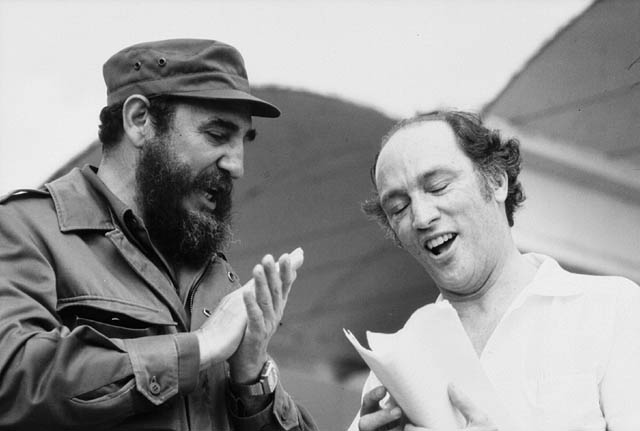
Castro_trudeau


Next on the agenda are the imaginative and rythmically edifying jottings from an eminent lady of letters, Hannah Evans:

In Cuba a man named Fidel
Told America 'You go to hell'
His health is now ailing
His government failing
But his hat and cigar still look swell.


castro_2

I might add that this gentle-lady with a pen is mighty pissed off that the political email list she subscribes to has a 'no limericks' rule. And so we stand in solidarity with her as I was pissed off by that very same list's 'no long emails about the dream I had last night' rule.

(they also make fun of Sally whenever she brings up the subject of mimesis. That's just so wrong of them.)

- L.M. 3-06-2008 4:50 am [link] [5 comments]


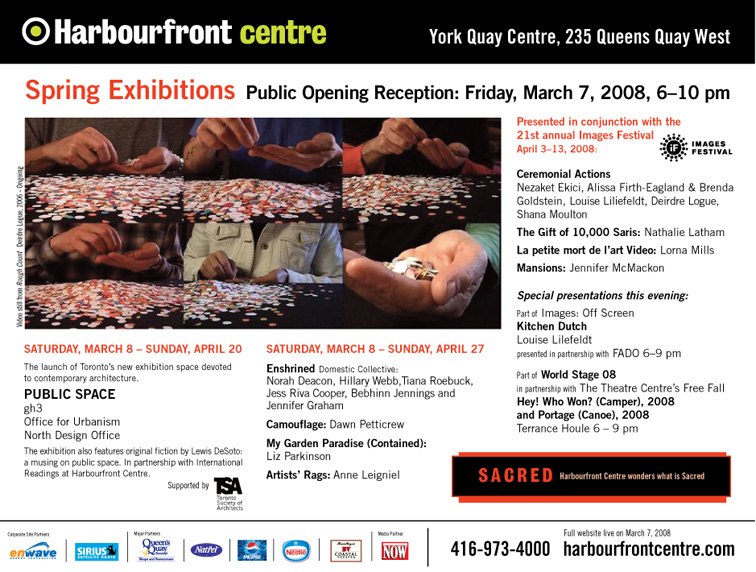
SACRED curated by Patrick Macaulay, at Harbourfront Centre opens this Friday, March 7, from 6 to 10 pm.

Both Jennifer McMackon and Lorna Mills (myself) are participating in this show as part of the 21st annual Images Festival.
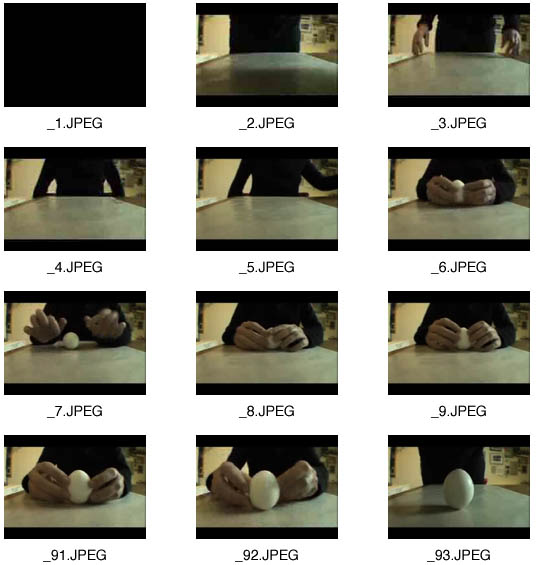
mansions

Jennifer McMackon 2008 Mansions Flip Book


Harbourfront_invite


- L.M. 3-05-2008 3:48 am [link] [4 comments]


They tried to make me go to grad school, but I said:


no_1


no_15


no_9


- L.M. 3-03-2008 5:29 am [link] [13 comments]


mirror neurons

This is an excerpt from my piece in Kiss Machine's Activity Book Issue.

Here is a better explanation of mirror neurons:
Mirror neurons are a particular class of visuomotor neurons, originally discovered in area F5 of the monkey premotor cortex, that discharge both when the monkey does a particular action and when it observes another individual (monkey or human) doing a similar action.
Rizzolatti G, Craighero L, “The mirror-neuron system,” in Annual Review of Neuroscience, issue 27 (2004) p. 1

- sally mckay 3-02-2008 8:14 pm [link] [1 ref] [add a comment]


Giacomo Rizzolatti, a neurophysiologist, and Laila Craighero, a neuroscientist, say this:
A category of stimuli of great importance for primates, humans in particular, is that formed by actions done by other individuals. If we want to survive, we must understand the actions of others. Furthermore, without action understanding, social organization is impossible. In the case of humans, there is another faculty that depends on the observation of others’ actions: imitation learning. Unlike most species, we are able to learn by imitation, and this faculty is at the basis of human culture. In this review we present data on a neurophysiological mechanism—the mirror-neuron mechanism—that appears to play a fundamental role in both action understanding and imitation. We describe first the functional properties of mirror neurons in monkeys. We review next the characteristics of the mirror-neuron system in humans. We stress, in particular, those properties specific to the human mirror-neuron system that might explain the human capacity to learn by imitation. We conclude by discussing the relationship between the mirror-neuron system and language.
Rizzolatti G, Craighero L, “The mirror-neuron system,” in Annual Review of Neuroscience, issue 27 (2004) p. 1

- sally mckay 3-01-2008 4:24 pm [link] [add a comment]


Michael Taussig, an anthropologist, says this:
The wonder of mimesis lies in the copy drawing on the character and power of the original, to the point whereby the representation may even assume that character and that power. I an older language, this is "sympathetic magic," and I believe it is as necessary to the very process of knowing as it is to the construction and subsequent naturalization of identities. But if it is a faculty, it is also a history, and just as histories enter into the functioning of the mimetic faculty, so the mimetic faculty enters into those histories. No understanding of mimesis is worthwhile if it lacks the mobility to traverse this two-way street, especially pertinent to which is Euro-AMerican colonialism, the felt relation of the civilizing process to savagery, to aping.
Michael Taussig, Mimesis and Alterity: A Particular History of the Senses (New York; London: Routledge, 1993) p.xiv
Jimmie Durham, a Cherokee artist and activist, says this:
Europe, or the Western World, or Civilization, has been going around watching everyone for some time now. The good part of this is a kind of self-observation, so that we have complicated novels to read, and art that attempts self-exploration and intervention in the given narrative and, at the same time, a little distance. The bad part is that the Western World has not observed itself observing. It has not seen how active, how transforming, its watching has been for itself. The West (I can't keep writing the "Western World," though "the West" is even more ambiguous) has not imagined itself as defined by its colonial enterprises and engagements. Instead, it has continuously imagined barriers and borders between itself and constantly reenforced Others.

But listen to this: "The border has dissolved and expanded to cover the lands it once separated such that all the land is borderland, wherein the imagesphere of alterities, no less than the physiognomic aspects of visual worlds, disrupt the speaking body of the northern scribe into words hanging in grotesque automutilation over a post-modern landscape where Self and Other paw at the ghostly imaginings of each other's powers." It's Michael Taussig, in his book Mimesis and Alterity. When I first saw the title I thought it was awkward and academic, but that's because I didn't know the word "alterity." (I'm afraid I suffer from the American disease that causes anger at things, especially fancy words, one doesn't know.) After reading the book, though, I wrote to Taussig to tell him he had written things I'd always intended to think but had been unable to.
Jimmie Durham, "Mimesis and Alterity" (book review) in Artforum, (December 1993) full text online

- sally mckay 3-01-2008 4:01 pm [link] [add a comment]


Merlin Donald, a cognitive neuroscientist with a background in philosophy, says:
"A mimetic act is basically a motor performance that reflects the perceived event structure of the world, and its motoric aspect makes its content a public, that is, a potentially cultural, expression."
Merlin Donald, “Imitation and Mimesis,” in Perspectives on Imitation, From Neuroscience to Social Science, Vol 2, Hurley, Susan and Chater, Nick eds. (Cambridge: MIT Press, 2005) p. 281

"Mimesis is the reduplication of an event for communicative purposes. Mimesis requires that the audience can be taken into account. It also demands taking a third-person perspective on the actor's own behaviour."
Merlin Donald, ibid., p. 286

"Mimesis is an analogue or holistic style of thought that is more basic to our uniquely human way of thinking than language or logic. Indeed, on present evidence language and logic evolved much later, from a mimetic platform. Mimesis is a foundation skill that arrived early in evolution, and defined the human style. The components of mimetic cognition are present to some degree in primates, but are vastly more developed in humans. this makes mimetic culture a logical, but radical, extension of the primate mind. It remains an important force in human affairs, and produces such typically human cognitive patterns as ritual, skill, gesture, tribal identification, personal style, and public spectacle. It explains our irresistable tendency to imitate one another and conform to patterns of group behaviour, especially group emotional expression. It sets the tone of human social life, and it is the ultimate driving force behind art, which might be viewed as the ultimate refinement of the mimetic mode."
Merlin Donald, "Art and Congitive Evolution," in The Artful Mind, Mark Turner, ed., (New York: Oxford University Press, 2006) p.15

- sally mckay 2-29-2008 12:48 pm [link] [11 comments]

older posts...